
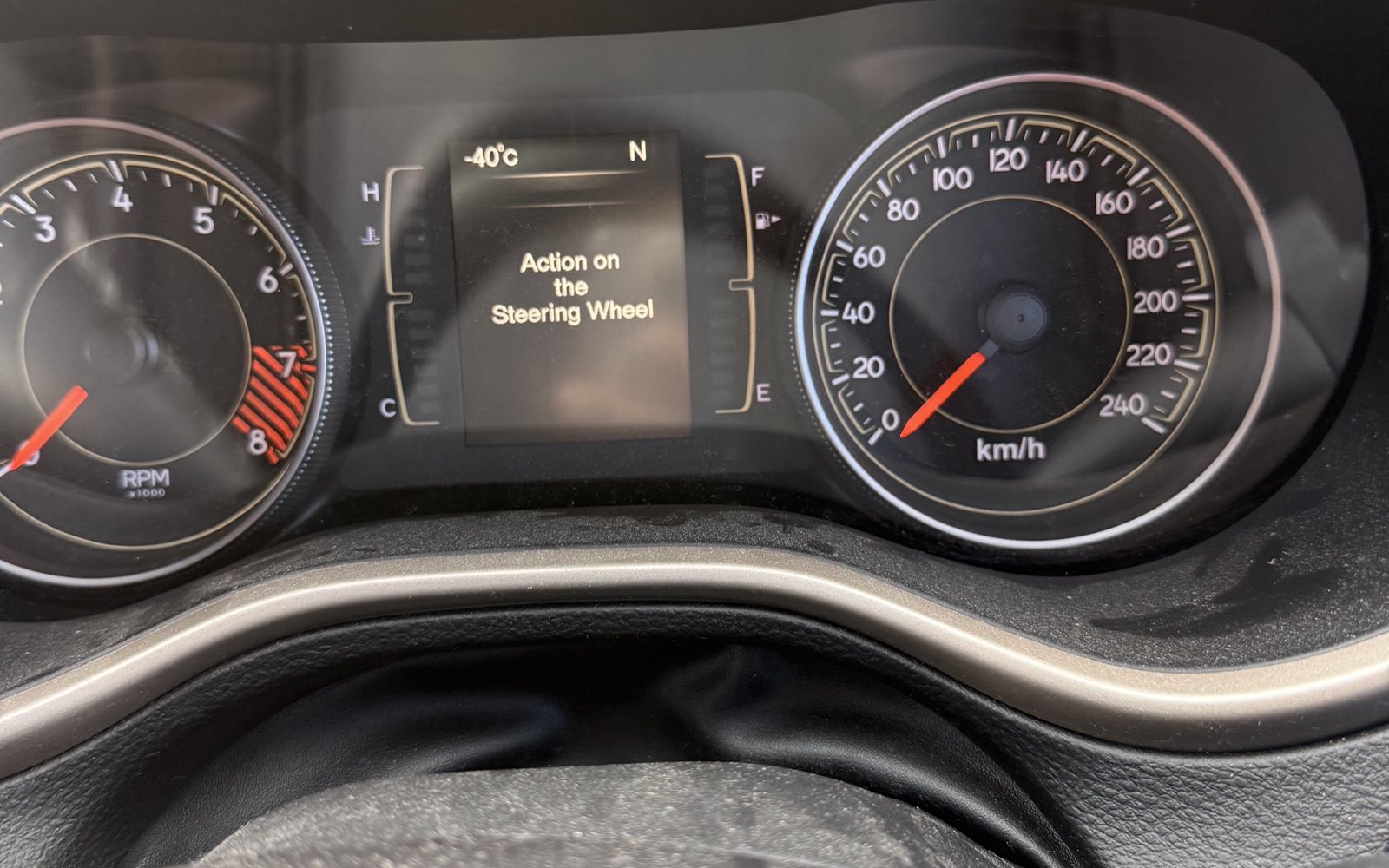
If your Jeep Cherokee will not start, the most useful thing you can do before anyone touches it is work out which kind of no-start you have. An engine that never turns over and one that spins but never fires are different problems with different causes — and a locked steering wheel alongside either is worth noting, but does not on its own confirm a steering lock fault.
First: does it crank, or not?
Attempt to start the vehicle using its normal starting procedure and note what happens. Avoid repeated attempts.
- No crank. Nothing turns over — silence, a single click, or rapid chattering, and the dash may dim or drop out.
- Cranks but will not fire. The engine spins at a normal speed but never catches.
Those point at separate systems. In the first, the engine is not being turned, so the question is power, the starter circuit, or whether the vehicle is authorising a start. In the second, the starting circuit has already done its job.
One safety point before you try anything else: do not attempt to push-start or tow-start the vehicle. A car with an automatic transmission cannot be started that way, and attempting it risks damage.
Why a lit dashboard proves less than you would think
Dash lights and central locking draw very little current; a starter motor draws hundreds of amps. A battery can light the dash perfectly while being incapable of turning an engine, because resting voltage says little about behaviour under load.
The same goes for connections. A corroded terminal or tired earth strap can run the lights and still lose enough voltage under starting load to stop the starter dead. "The lights all work" does not clear the battery, terminals or earths; those have to be tested under load.
Where no-start faults usually sit
- Battery, terminals and earths — capacity under load, terminal integrity, and the engine-to-body earth path.
- The starter circuit — whether the start request reaches the starter with enough voltage behind it, and whether the starter responds.
- Starting authorisation and starting conditions — the vehicle has to agree to start. A factory immobiliser disables the engine unless the key is recognised. Separately, an automatic normally has to register Park or Neutral before it will crank, and some starting systems also require a brake pedal input before they will authorise cranking — that brake requirement depends on the starting system fitted, and is not universal. A brake/transmission shift interlock is a different thing again: it governs shifting out of Park, not whether the starter turns. Which conditions and modules apply depends on the build, and is worth confirming on your car rather than assuming.
- Steering lock, where one is fitted — covered below, because it is widely misread.
- Module power supplies and communication — modules need clean power, clean earths, and the ability to talk to each other. One that is awake but not communicating can produce symptoms that look nothing like a flat battery, including faults that come and go.
A locked steering wheel is not proof of a steering lock fault
Two things get confused here. The first is ordinary mechanical behaviour: on a vehicle with a steering lock, parking with the front wheels turned hard against a kerb loads the mechanism, and the wheel can then feel stiff or jammed. Resistance at the steering wheel on its own does not confirm that a steering lock has failed. Your vehicle handbook sets out the normal starting procedure and the steering-unlock procedure for your car — follow that rather than improvising.
The second is assuming a steering warning confirms a failed lock. It does not. Steering warnings can come from power steering, steering angle sensing, or a module that has lost power or communication — and one supply fault can set several unrelated-looking warnings at once.
Be careful with exact wording, too. Dashboard messages and fitted equipment vary by model year, build and market, so a phrase quoted on an overseas forum may not match what your vehicle displays. Photograph any message rather than paraphrasing it — the exact words matter.
What a proper diagnostic assessment checks first
Before any part is recommended:
- Battery capacity tested under load, not just resting voltage
- Voltage drop across terminals, main cables and earth straps while starting is attempted
- Whether a start request reaches the starter circuit at all
- Whether the vehicle is authorising the start — immobiliser and key recognition status
- Transmission park/neutral position signal
- Module power supplies, earths and communication, with codes read from every module rather than the engine alone
- Whether the fault is present right now, or intermittent
What to tell us when you book
- Year and engine
- Whether it cranks, or does not crank at all
- The exact wording of any dashboard message — a photo is ideal
- Whether it is constant or intermittent, and whether it relates to heat, cold or damp
- Whether the steering wheel feels locked or stiff, and whether the wheels were turned when you parked
- Any recent battery, jump-start, accessory or electrical work
Observations you can make yourself, without tools: look at the battery terminals for corrosion or looseness, try your spare key fob, and note whether the dash dims when you attempt a start.
On-site assessment is available within our service area around Geelong and the surrounding suburbs, which helps when the car cannot be driven. Some vehicles still need towing or workshop-based work, depending on the fault and the vehicle. My diagnostic call-out fee is $150, and that includes on-site troubleshooting and testing. Repairs will be quoted after the fault is confirmed. Read how we approach car electrical diagnostics, or get in touch.
Frequently asked questions
My Jeep Cherokee will not start and the steering wheel feels locked. Is the steering lock the fault?
Not necessarily. If the front wheels were turned when you parked, the mechanism can be loaded and the wheel can feel stiff. Resistance at the steering wheel on its own does not confirm lock failure. Check your vehicle handbook for the normal starting and steering-unlock procedure, and treat a stiff or locked wheel as a symptom to investigate rather than a confirmed cause.
I found a steering lock message online — does it apply to my Cherokee?
Not necessarily. Dashboard wording and fitted equipment vary by model year, build and market, so a message described on an overseas forum may not match your vehicle. Photograph the exact wording on your dash and we will work from that.
The dashboard lights up, so can the battery still be the problem?
Yes, and it often is. Lighting the dash takes a tiny fraction of the current a starter motor needs, so a battery or connection can be fine for the lights and still collapse under starting load. Capacity and voltage drop have to be tested, not assumed.
What is the difference between no crank and cranks but will not start?
No crank means the engine is not being turned over, pointing at power supply, the starter circuit, or the vehicle not authorising a start. Cranks but will not start means the starting circuit has already worked, so the fault lies elsewhere.
Can you assess the car where it is?
On-site assessment is available within our service area around Geelong and the surrounding suburbs. Some vehicles still need towing or workshop-based work depending on what the fault turns out to be, so on-site repair cannot be promised in advance.
Jeep Cherokee not starting? Book diagnostics or call 0406 642 600.


